Showing posts with label bees. Show all posts

Thursday, February 24, 2011

Crocus Bees, Bats and Insect Mysteries


Honey Bee in Snow Crocus February 23, 2011

It is a chilly and rainy day in the Appalachians with temperatures in the 40s. Still, it has been unseasonably warm and dry. The rain is welcome as the fire danger has been very high with over 4000 wild fires reported in Virginia.

The honey bees have been foraging pollen in the past week. They get a little pollen from the few crocuses I have been blooming. From what I learned from local beekeepers, they are also foraging on willow and alder which generally grows near waterways--over a mile away.


Honey Bee on Yellow Crocus February 23, 2011

This yellow crocus bloomed yesterday while the snow crocuses pictured at the top have been blooming for a week. Now that I know bees like crocuses, I will buy a bunch next fall. I don't want them to have to fly a mile away to the willows if they can forage right near their hive.


Hive Inspection--journal entry
February 17, 2011

I inspected the beehive last Thursday (I noticed my journal date was wrong!)--first time since last fall. My main task was to see if they had enough winter stores of honey. They appeared to have plenty--many frames still uneaten. There was some pollen stores but since I have been seeing them bring in pollen, that might be alright. I did a varroa mite check--leaving the mite board in for a week and only saw a couple of mites so that's good. I did not see any signs of other problems like nosema. It's hard to estimate the number of bees but it's over 10,000. That should be alright if the queen has been laying eggs.

I did find the queen in the second box because she is still marked from my mentor last summer. She might have been laying eggs but I wasn't about to brush away bees to see. I carefully put that frame back into the box. I just lifted the bottom box (light probably no honey but with lots of bees) and put the whole hive back together.

Back at the house, I wrote notes in my journal right away. The journal page you see above is very different from what some beekeepers do. It is not super detailed but it has enough information for me. I also am very visual so drawing the hive components lets me put notes right where I found something to note. Doing my notes afterwards allows for a quick inspection, probably no more than 20 minutes.


Dutch iris bloomed yesterday for the first time. These little bulbs only last a few days but are appreciated because they bloom so early when a week of warm weather comes around.

Bat Mystery

As I was walking in the woods, I saw a bat fly very low from the direction of our house into the woods. This is way too early for bats to come out of hibernation. I have learned that the fungus (another nosema) that is killing the bats in the east makes them come early out of hibernation and the bats perish from starvation. I hope that bat I saw doesn't die.


Insect Mystery


What is this growth on this small American Beech tree?


It's about 5 inches long and papery with something inside. I think it is some type of pupae that is overwintering. Does anyone have any ideas?


My cat, Sophie, loves to walk in the woods with me where she can climb up as high as she can get.

With days like these, spring cannot be far behind!

Wednesday, November 18, 2009

Fern Driveway, Milkweed, and Native Bees

It's a rainy cool Wednesday so thought I'd post some photos from the last two weeks.


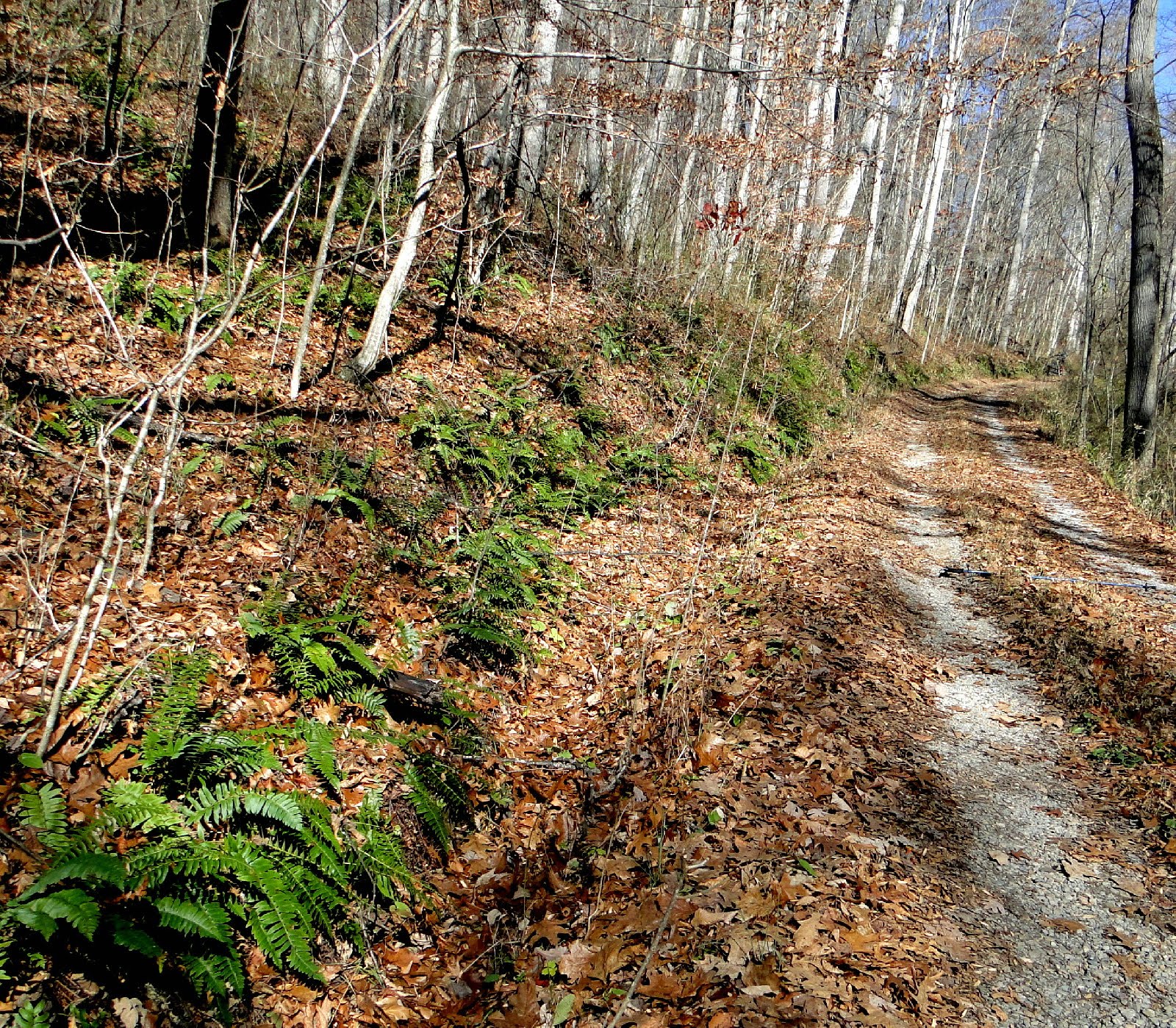
Christmas Ferns November 6, 2009

Once the leaves fall, the Christmas Fern (Polystichm acrostichoides) is more noticeable since it stays green all winter (perhaps accounting for its common name).


This slope along our driveway used to be red clay before the ferns colonized it. I try to keep it in ferns by pulling out the multi-flora rose.


Common Milkweed November 6, 2009


There seems to be more milkweed along our road this year, all the better for the monarchs. Maybe it has something to do with the state budget cuts--less mowing. I wish they wouldn't spray or mow the roadsides--maybe just cut the tree saplings every few years. The insects would appreciate that.


The pods open up in October and were still opening up this week.


Carpenter Bee November 16, 2009

The temperature was in the 70s for several days so bees were still out. The only blooms I noticed were on this heather shrub (usually blooming in late February). Sweat and carpenter bees were seen on the tiny flowers. The carpenter bee does hibernate in the winter so he or she must have been trying to warm up before crawling back into their hole (probably in our house's siding).

I won't probably be getting out too much until after Thanksgiving--it's the deer firearms season. I read this morning that a Ferrum College student was killed by a hunter only one mile from campus. I wear blaze orange anywhere outside (unless I'm in town). While most hunters are responsible, it only takes one reckless person to create a tragedy.

Wednesday, September 2, 2009

Butterflies on Thistles

I'm behind on posting but still wanted to put up these photos I took 10 days ago. Our back pasture was filled with thistles covered with many swallowtails (giant, spicebush, tiger), fritillaries and other butterflies. Talk about a butterfly garden!


Spicebush Swallowtail

The spicebush swallowtail is our most often seen butterfly, probably because we have a lot of spice bush, its host plant, in the woods.


Tiger Swallowtails

These butterflies are also quite common maybe because their host tree, yellow or tulip poplar, is in abundance.


Great Spangled Frittilary

I believe the thistle is a bull thistle, an alien plant.


Orchard Mason Bee

Bees also love the thistle. I saw bumble bees, orchard mason bees, and many smaller bees but no honey bees.

Thistles are not a flower I would want around my house because of the thorns. But I don't have a problem with letting them grow in the pasture for the insects.

Tuesday, March 31, 2009

Bees' Knees (Corrected)


Honey Bee on Glory-of-the-Snow (March 22, 2009)

Since I posted this yesterday, I have received replies from several entomologists so I corrected this post. First, the yellow bee is actually a fly! Feral colonies of honey bees can exist in this area.

I have paid more attention to bees lately because this year I am becoming a beekeeper! When I was researching about honey bees, I wanted to find out whether the honey bee, essentially an alien, would harm the wild bees, that is replace them. Since honey bees have been with us since colonial times, it's not surprising that I didn't find out much about this issue online.


Bumble Bee (July, 2008)
So, I have been watching my favorite, the Bumble Bee, to see if my new colony of 12,000 bees arriving this Friday, April 3 would interfere with it. For a week, I have observed bumble and honey bees foraging together on my Glory-of-the-Snow tiny blue flowers. Besides these two bees, I saw two other types, both smaller than the honey bee. Even the wasps were getting along with the bees.


On this photo, you can see how the honey bee carries pollen in a pouch on his legs (or knees? Ha!) while she sucks the nectar. Both foods will be carried back to the hive.

I also inquired about where those honey bees might have come from because I understand they don't usually forage more than a mile from their hive. Honey bees can survive in the wild in our winter, especially if they find a good hollow tree, their natural nest. I since learned that a couple of farmers keep hives about 2 miles away.


Dung Fly (Scathophaga stercoraria)

My interest piqued, I went up in our back pasture looking for more bees. Instead, I found this Dung Fly feeding on cow manure.


Luckily no one saw me on my hands and knees over the cow manure (thankfully not fresh), studying these flies.


Spring Azure Butterfly in flight

While I was up in the pasture on March 22, I saw my first Spring Azure butterfly. You can only see the beautiful blue azure color as they fly. When they land, they keep their wings up and the undersides are a dull gray. I tried to capture the beautiful blue azure color but I guess my shutter speed wasn't fast enough. In a way, the photo's a lot like what you experience when you see them fly--a flash of blue.

Friday, September 14, 2007

A goldenrod community

It's 67 degrees at 10:30 a.m. on a cloudy, thankfully rainy, day in Virginia.

Earlier this week, I attended a great naturalist presentation by Frank Taylor, a local high school biology teacher. During his talk, he mentioned plant/insect interactions and specifically goldenrod and a yellow and black beetle. His talk inspired me to look at goldenrod a little closer.

Yesterday, I looked for monarch caterpillars--about 6 of them I have been observing all week in a couple of old pastures. They were nowhere to be seen but I could not find any chrysalis either. So, I turned my attention to a stand of goldenrod.


The beetle Frank mentioned was there in profusion.


The yellow and black striped beetle is the locust borer, whose larvae wreak havoc on the black locust. But, other insects also caught my attention...


A locust borer and spider wasp feed together on one plant.


I caught this hornet in an unflattering pose. Besides these insects, I saw soldier beetles, butterflies, and a variety of bees.

The insects on the goldenrod make me reflect on the finding this week that scientists believe they have found the cause of what is killing the honey bees: a virus. Honey bees were originally from Europe and they are kept in hives in close quarters. Hundreds of these hives might be trucked to farmer's fields which consist usually of one crop. So, in contrast to the diversity of insects in the goldenrod community, the same species of bees is counted upon to pollinate the crops. Viruses are known to be more prevalent where people are in close quarters (e.g. schools, offices) so it is not surprising to me that honey bees would succumb to viruses. Perhaps the beekeepers could learn something from the goldenrod community.