Showing posts with label honey bees. Show all posts

Tuesday, June 2, 2015

Flowers in My Yard in May

May has flown by without a post but I still wanted to save these photos of my yard.  These two Rhododendron shrubs are taking over!  I cut them back on the other side to give my blueberry bushes more room.  Now, I had to cut back to let my native Dutchman Breeches grow.  But, I really enjoy the lovely flowers in May.

 Mayapple blossoms are already gone with apples now forming.  But this is one of my favorites.

The native wild geranium also has gone to seed.  I transplanted one plant years ago in my yard and now have hundreds of plants.  I always see lots of native bees on the flowers which is good.

 This purple columbine is not the native one but one I bought from a nursery.  It also has spawned many other columbine plants via seed, such as the white columbine that sprouted underneath the steps.

I like the white version so much so I wonder if I save this seed that I might get more white ones?

The biggest surprise is that I have bees again! Let me explain.  I went into the winter with one strong colony of bees which was still alive in early February but the colony froze during sub-zero temperatures in late February.  I did not mourn the loss as those bees were very aggressive. My husband and I decided we would wait until next year to buy more bees.

 I had placed a couple of empty hive boxes on our bottom deck and noticed a few bees going in there for several days in early May.  On May 7, a swarm of honey bees occupied the box.  It was easy to move them to my original "Princess" hive.  The bees are very gentle, much like the original Princess colony that swarmed two years ago.   Maybe they came back! 

Thursday, January 26, 2012

Fox and Bees


Red Fox January 23, 2012

My husband gave me a wildlife camera for Christmas--so far, just photos of my dog and cats. But, I moved it to the driveway where it captured a photo of this red fox on Monday night. The lens appears to have raindrops on it. I think the fox was just as happy to get out after 3 days of rain. According to Eastern Forests, it is their mating season right now.

At first, I thought it was a coyote because of the color but red foxes go through a black and intermediary phase. Also, the fox has a white tip at the end of the tail as shown in my photo rather than black like a coyote. The fox carries its tail straight out, like in this photo, while the coyote carries its tail down while running or walking. I'm fairly sure of the identifcation of a fox after looking at this site:

http://blog.wildsidenaturetours.com/2009/06/fox-or-coyote.html

Another thing that threw me off at first was the tail which is usually fluffy. This fox's tail looks like somebody got a good chunk of the fur resulting in it looking a little more like a coyote. The tail also might have been wet from all the rain.


My Bees Survived


I was worried about my new "Duchess" hive because I hadn't seen the bees out on the many warmish days unlike the older "Princess" hive which had bees coming out on 50ish days. On Tuesday morning, it warmed up quickly to above 50 degrees and the new hive was just swarming with bees, so much so I thought it was being robbed. But, it wasn't. I saw some bees coming out yesterday as well.

I named my new hive "Duchess" partly after the name of the paint for the bottom board and top (Duchess Blue) and also because it was close to the royal wedding (May 2) when I got my nucleus hive. Then, "Princess" seemed like the right name for the older hive. I would like to restain and paint the older hive since the old hive is starting to show deterioration from 3 years of being out in the weather.


Heather January 24, 2012

I saw a few bees on this heather which has been blooming for a month or more.


I am still amazed that it blooms in the winter, even with all the warm weather. I wish I had more than one heather shrub for the bees.

Yesterday, I cut back multi-flora rose, hoping to eventually kill it by starving its roots. I usually do this in late February or early March but I had noticed it was already starting to leaf out. It's been an unusually warm winter so far.

Thursday, June 9, 2011

Catalpa Memories


My honey bees have been flying southeast high into sky. I wondered where they might be foraging for nectar and pollen since not much is blooming nectar-wise for them. As I drove down our road, I noticed several Catalpa trees blooming. When I stopped to inspect, I heard the familiar sound of pollinators. While I only saw a few bumble and carpenter bees on the lower branches, I was sure honey bees were at the top of the tree. These trees are located about a half-mile in a straight beeline southeast of my bee hives.


Common Catalpa (Catalpa bignonioides)

For years I have driven by these trees and not paid much attention to them. I am glad my bees make me notice these and other flowers. These trees are not native to this area, originating in the Gulf Coast of the United States. The trees were probably planted as fence posts (Trees and Shrubs, Peterson Field Guide). The guide also states that they produce "catawba worms" that fishermen use as bait.


As I photographed the tree and flowers, memories of my childhood came back to me. A large Catalpa tree grew along the fence of our front yard where I grew up in a town outside St. Louis, Missouri (now a suburb). My sisters and I would put the Catalpa flowers in our hair. Later when the large seed pods appeared, we sat in a circle under the tree and tried to smoke the "cigars" or long seed pods.


On another note, I photographed these flowers this morning and am wondering what they are. The bell-shaped flowers are about an inch or so long and quite showy.


Purple Clematis (Clematis Verticillaris)

They are growing on a vine with three leaflets with simple leaves. Does anyone know what this vine is?

Mystery solved by Randy: It's Purple Clematis, a native vine that is in the buttercup family. My Peterson guide pictures the flower a little differently--no curls on the end of the sepals so I guess that's why I missed it. Anyway, I am glad to have another native plant and it's close to the area where I discovered the orchid this spring.

Saturday, January 15, 2011

The Birds, Bees and Honey


Tufted Titmouse and Junco January 11, 2011

Snow has covered the ground for the past three weeks. But we have been lucky that the severe storms have missed us, going east, south and west. I guess that makes up for the past winter when our area was targeted with heavy snows.

The birds have flocked to the feeders so we have already bought 100 lbs. of black oil sunflower seeds this month. But, the sight of hundreds of birds at the feeders makes it worth it.


Bee Hive January 14, 2011
(yes it's sloping, I keep propping it up until spring when I can try to reset the concrete blocks)

So far so good with my bees this year. On Dec. 31, we had a warm 50 degree day. I noticed hundreds of bees swarming around the hive at 1:00. At first, I thought other bees were robbing the hive since I thought I saw bees kill other bees. Later, I went outside and only a few bees were outside. I noticed that each one was dealing with a dead bee. I watched one push a dead bee to the edge of the bottom board, then fly a little ways and drop to the ground with it. The bee then returned to the hive. There was a big pile of dead bees right where the bee dropped that dead one. The bees were cleaning out the hive of dead bees! The next morning, I noticed all the dead bees were gone, probably a yummy treat for the birds. That might have been the first warm day since the bees went into their winter cluster.

I also noticed a few bees out when the temperature reached 40 degrees yesterday. They didn't go far and appeared to be eating the melting snow. I hope they made their way back to the hive in the chilly weather.


Costa Rican Honey

I bought some honey at a roadside fruit stand while we were in Costa Rica. It was a good thing it had bees on the label because the vendors could not speak English and my Spanish is poor. By the time we got back to the hotel, the bottle was leaking. So, I bought packing tape and sealed the bottle cap up good and put it in several ziplock bags. I hoped that the TSA wouldn't find it because it looked very suspicious (and I read an article once about a man getting detained for trying to bring back jars of honey on a plane flight).

The bottle made it back in my checked luggage . I was delighted that the honey was quite good. It reminded me a little of orange blossom honey but a little richer with tropical flavors. I am becoming knowledgeable of the different flavors of honey. Right now, I have several varieties of honey on my shelf--locust (my very own), sourwood (from my mentor), orange blossom (from the farmer's market), and now my Costa Rican honey.

I put my bottle of honey next to my little bonzai. It reminded me that last summer, the bees would sit under the bonzai, sipping the water from the damp soil. I know I took a photo but lost it when my desktop computer crashed last year.

I am already thinking about spring!

Saturday, November 13, 2010

Witch-Hazel and Honey Bees

I awoke to the sounds of gunshots because today is the first day of deer firearms season which lasts for two weeks (except Sunday--hurray for the religious). I am afraid to go out in the woods to take photos even with wearing a blaze orange vest and hat. Forget about taking the dog out for a walk as Kookie only has the blaze orange collar. She looks just like a deer running in the woods.

So instead of walking, I am sitting here at the computer doing this post on a gorgeous sunny warm day.


Yesterday, I noticed my honey bees were out and about bringing in water and pollen. That's not surprising since the weather has been nice and warm (70 degrees most of the week). But where were they getting the pollen? The goldenrod and wingstem are long past flowering--the same for the asters.


I did notice this solitary dandelion blooming but that was probably not the source.


Then, I spotted the witch-hazel tree that was in full bloom. Sure enough, there were honey bees all over it. The witch-hazel is special that way--always blooming in November, a welcome respite from all the brown.


This close up of the flowers was posted on my blog a couple of years ago with the following text:

The Witch-hazel is an understory tree that is fairly common in our woods and a favorite of the Wood Thrush bird for their nests. The leaves are aromatic and can be used to make astringent lotions. Some old timers use the forked branch of the Witch-hazel branch to detect underground water.


This was an earlier photo of the beehive about a week before. The entrance reducer is pushed out so that the bees were able to come and go as they please. I swear I saw them pushing the entrance reducer out themselves! Anyway, the reducer is used to keep predators out but especially mice which will come in and build a nest making a mess. I made my own from 1 x 1 trim. I put 4 holes in it since I knew they wanted more than the typical small hole.

Thoughts on Hive Winter Preparation

This year I left a lot more honey on the hive, (2-1/2 medium boxes). It seemed I had twice the number of bees going into the winter as last year so it made sense to me. The bottom one had brood and lots of pollen storage. I figure the winter cluster can gradually move up the hive through the honey which also should help insulate against the cold.

I'm keeping my fingers crossed that I won't lose the bees this winter like I did last year. But one thing I noticed about these bees is that they seem a lot healthier than last year's bees. I kept doing varroa mite checks all summer and did not see any until the very last time when I counted about 5 (used powdered sugar treatment to check). Last year, I counted over a hundred on last check. Nevertheless, I plan on leaving the mite board out of the screened bottom board to allow any mites to fall off to the ground and to allow plenty of ventilation. Last year, I got so concerned about the cold that I left the board in. Maybe the mites got to them or the lack of ventilation made them susceptible to nosema (a fungal infection).

Thursday, August 26, 2010

Foggy Bottoms and Sunny Pastures: Buckeyes and Mist Flowers


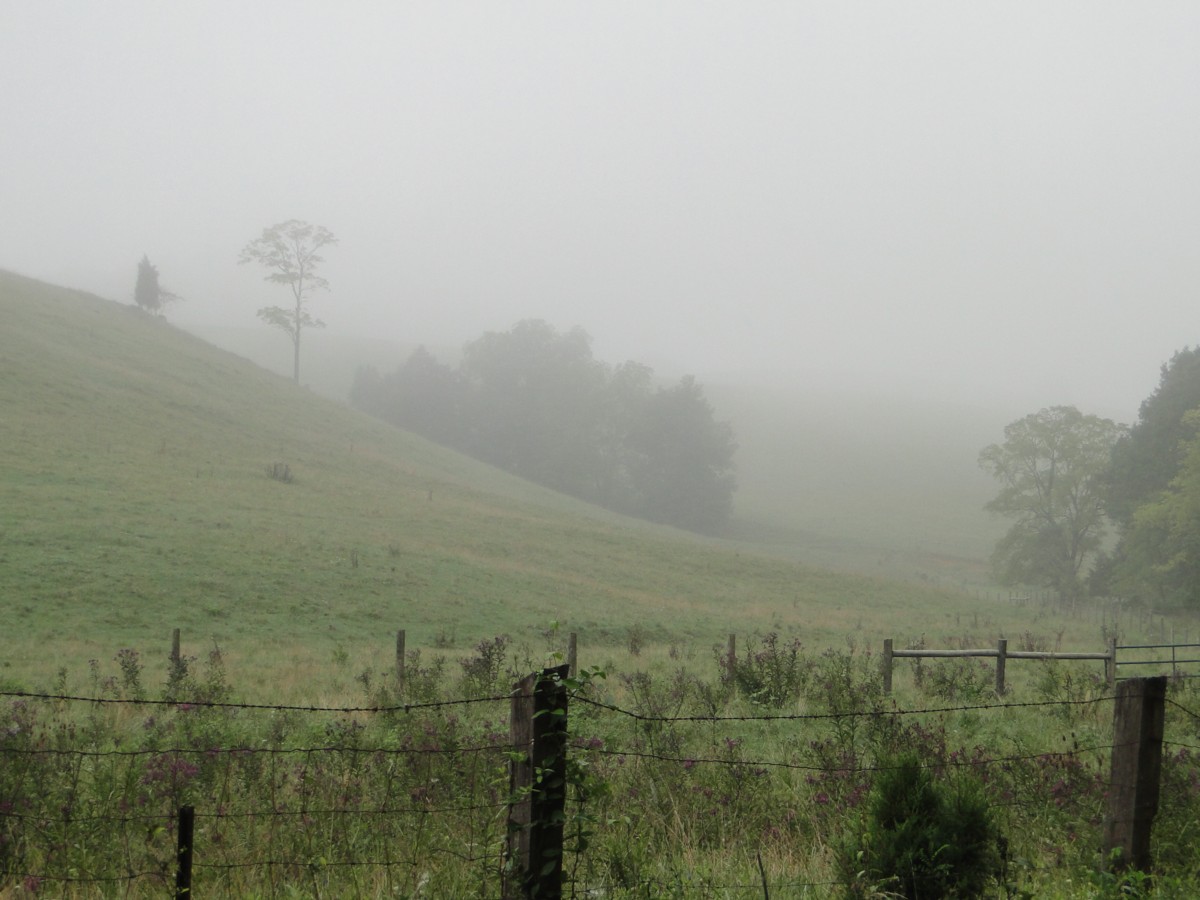
This morning I walked down our 1/3 mile driveway to get the newspaper. I was in such a funk I didn't even notice that it was foggy until I got down to the bottom.

After the fog burned off, I decided I should take our UTV up on the back part of our land to plant peach and plum pits. I hadn't been up there for over a month.


I was delighted to find mist flowers growing on the very back---up on the side of the mountain. These flowers are often found at the local nurseries but are native to this area.


This soldier beetle seemed to be the only insect on the flowers.


Lots of knapweed (maybe Brown?) grew in the back grown up pasture attracting honey bees like this one. I had been wondering where my bees have been foraging lately. They go out early coming back to the hive with loads of yellow and white pollen. The knapweed was full of them.


I also saw several Buckeye butterflies on the knapweeds and grasses here. Everytime I see a buckeye, I am reminded of the time when I did a lot of embroidery when I lived in Logan, Utah in the 1970s. I had such a good reputation for doing jean embroidery that a friend asked me to embroider his wedding shirt (cowboy shirt of course). I ended up embroidering a giant buckeye butterfly on the back which he loved. I thought I had a picture of it but alas no.


This Buckeye was rather worn for wear. Neither of the photos turned out great (like Nina's)but I wanted to post this close-up so that I can remember the patterns. Maybe I will try another embroidery like that someday.

I planted the peach and plum pits in this pasture so I'm hoping someday to pick fruit up here.

There's nothing like getting outside and enjoying nature to lift your mood!

Monday, March 15, 2010

Nature's Fury: Floods, Winter Critters, and Dead Bees

My husband and I went to Death Valley last week to escape the fierce winter in southwest Virginia (more on this trip in the next post). While we were gone, the weather warmed up and all the winter snow melted. Then, 3 inches of rain fell Friday night, flooding many parts of our county.

Floods


Flooded Walker Creek March 13, 2010

By 1:30 in the afternoon on Saturday, this creek was backed up from Walker Creek which was higher than I ever remember it. From here it is almost 100 feet to Walker Creek, well over the road.


I zoomed in to see the raging Walker Creek.


My neighbor's house flooded--something that hasn't happened since the mid-80s. Creeks all over the county were over their banks while a mudslide closed highway 460--a major thoroughfare.

Winter Critters

Snow covered the ground since late December. Even with the freezing weather, the creek in the valley ran, attracting wildlife during the day.


Wild Turkeys February 19, 2010

Several days, I saw a flock of wild turkeys drinking water out of the same creek that raged last Saturday. I also saw deer foraging during the day in the valley--a little unusual but the only pasture that was green was along this small creek.


Once I got out of the car to take more photos, the turkeys fled into the cedars. When we returned from our trip, I noticed the turkeys were roosting in the trees around our house, something they started no doubt while we were away.


Fox Squirrel March 1, 2010

A regular visitor to our feeder this winter was the Fox Squirrel. We usually only get gray squirrels so this large squirrel was welcome. You can tell the snow had melted by the first of March behind the squirrel---that was only on the south-facing slopes. The north sides of the mountains were deep with snow.


Here you can see the size difference between the fox and gray squirrels although I have seen gray squirrels larger than this one.


American Possum February 20, 2010

Possums came during the day and foraged what they could on the ground and in my compost pile. At night time, the raccoon would come if I didn't put the bird feeders in the shed.

A small possum came near my beehive one morning so I went and chased it with a stick. He was so frightened, he climbed high up in a small tree. That night he expired and his dead body is still in the tree, only attracting a tufted titmouse bird which plucked some fur for his nest. I am still waiting for the vultures or a red-tailed hawk to come get it. I felt bad about scaring the poor possum to death.


Dead Bees

Last Friday, I inspected my beehive and as I suspected, the bees had died. I last saw them on February 21 when a few were out on a somewhat warm, 50 degree day. Since then, the weather turned cold until March 5 when we left on a trip for the week. I called my mentor who told me he had lost almost half of his 12 hives also. What he thought happened was that there was not enough warm days for the bees to break their winter cluster and eat their stored honey so they starved. He said one dead cluster had honey within 2 inches of it. He told me it wasn't my fault.

I do think my bees starved also. He instructed me to remove the dead bees and close up the hives so flies couldn't get into it. When I did, I noticed that the bees in the top of the hive were filled with a yellow liquid--so they hadn't starved but the ones in the cluster were completely dry so they probably starved. But, I might have caused it by putting a feeder (2:1 syrup) on the top. The top medium hive had plenty of honey which I wasn't able to check because of the freezing temperatures (opening to check weight would have killed the bees). I noticed the honey bees had filled the central space of that box with the syrup. The winter cluster had moved down to between the 1st and 2nd box (3 boxes total). There, they were far from the honey stores. With the constant freezing temperatures for so long, they had no chance. I believe if they had stayed up in the top box, they would have been better insulated and close to the honey stores. My mentor says they probably would have starved anyway.

I also wonder about the 8-frame medium box--does it need to be better insulated on the outside for our winters? The weather was indeed very cold but we did not experience any bitterly cold temperatures.

I did learn a lot from keeping bees this year and had ordered another package of bees to start a second hive. So, I will use it to fill this hive. Next year, I hope there will be intermittent warm days in the winter so I can check the hive. I will resist the urge to put liquid feeder on top of the hive. I feel sad about losing my bees but don't want to give up on this hobby.

Nature can be cruel sometimes.

Friday, January 15, 2010

Warm Up--Long Walk on Land and Bees Survived!


View of Walker Mountain January 14, 2010

Yesterday, the temperature climbed to 52 degrees so I went on a long walk to the back pasture of our land. The above photo was taken from the pasture. Most of the ponds were still frozen--to my dog Kookie's dismay. The only one that was partially melted was surrounded by cows so Kookie didn't get a chance to do her winter dip.


Yellow Poplar Dried Flower

The Yellow Poplar tree has these dried sepals on them. They're large--2 to 3 inches and look beautiful against the clear blue sky yesterday.


Bee Hive January 14, 2010

Yesterday was the first time I saw my bees out since Christmas day. They cleaned out the hive--putting out a pile of dead bees.

I bought a "pollen patty" from my local bee club. I put it on on the inner cover and about a hour later, I checked to see several bees on it, eating away as well as several bees coming up through the cover hole to check me out and then went up on the patty. I think the patty is good since I didn't really see a whole lot of pollen stored on my last inspection in November.

I lifted up the top box to check its weight--still heavy with honey so they have plenty of food. I think the bee cluster is in the middle box but I won't inspect until weather warms to 60 degrees--always a possibility.


Close-up of Bee Hive January 14, 2010

Glad to see they survived that long cold spell along with me. I already sent off a seed order to Gurney's--noticed about half of it was flower seed for the bees!

Saturday, January 2, 2010

"Joy is a Miracle...like Flowers in Winter"

That phrase was on a card I received over the holidays. Today, I went outside in the bitter cold (23 degrees and windy) and took the following photo which seems to encapsulate the idea.


Heather January 2, 2010

The flowers on this heather shrub have been blooming since late November. It seems like a miracle that the flowers survived 14 inches of snow that was piled on them for a week.


Honey Bee on Heather November 29, 2009

When the temperature rises to the high 40s, the bees will come out to feed on the shrub which they have to themselves (no wild bees out in this cold). I'm assuming my heather is the Bell Heather (Erica cinerea) which grows in the Scottish Highlands. The honey the bees make from the heather nectar is prized for its dark, caramel taste according to the book Honeybee: Lessons from an Accidental Beekeeper by C. Marina Marchese.

White Christmas

Although a lot of snow has melted on the south side of the mountains, the north sides are still deep with snow. I don't remember snow hanging around this long. On New Year's Eve, we received another 2 inches of the pretty stuff--better than the freezing rain that was predicted to fall. Here's some photos I took of the snow and ice.


Castle Rock on New River December 22, 2009

This photo was taken on Pembroke Bridge a few miles from where I live. Just below is the canoe and boat take out area.


December 25, 2009

Freezing rain on Christmas Eve helped to make the snow melt on our front porch roof creating interesting shapes.


On Christmas Day, the snow had slid off.


Hope everyone has a great 2010!

Tuesday, September 15, 2009

Bees on Wingstem, Kick the Bums Out!


Honey Bee on Wingstem (Actinomeris alternifolia)

My honey bees are foraging nectar and pollen for the past several weeks on Wingstem, a native plant in the composite family. The plant is easy to identify by the stems which have "wings" actually leaves on each side of the stem (seen in the upper right of the photo).


Wingstem in Pasture

The tall (4 feet or more) plants cover most of the pastures around here. Cows don't eat the plants so I am glad the farmers don't brush-hog the plants to get rid of this important source of nectar. Both bumble and honey bees collect orange pollen from the Wingstem. Fritillary butterflies were also on the flowers. I admit I never thought these plants were pretty but now I have an appreciation for this plant now that my bees seem to love it!

When I went back to the hive, I noticed that bees were collecting several different colors of pollen-orange, light yellow, and bright yellow. Perhaps they are foraging on the goldenrod but I haven't seen it (not much goldenrod compared to wingstem here).


Lion's Foot (Prenanthes serpentaria)

This lovely native wildflower, Lion's Foot, came up around my hive this summer. I did see a honey bee on it so maybe that's where they are getting the white pollen. I was surprised this flower was in the composite family (daises, dandelions, sunflowers). The leaves do look similar to dandelion leaves though.

My Bee Hive Update

My hive inspection of September 4 showed that the bees were very strong in 2 of the medium boxes (box 2 and 3 of 4)--good brood pattern surrounded by pollen and nectar. Bees were all over the 8 frames. On the bottom of the hive, box 1was almost empty of brood--and only a little pollen and not that many bees. Box 4 on the top had more bees and 3 frames of honey.

As I have done all summer (usually 10 day intervals), I used the powdered sugar treatment for varroa mites. This time, I kept the mite check board underneath just to see what I was getting. The next day, I counted about 150 mites on the board! Also worrisome was that I counted 3 wax moth caterpillars--these guys can ruin honeycomb quickly.

Last week, I attended the meeting of the local bee club (New River Valley Beekeepers Association). There I told the group about what I found. Jerry, club president, reassured me about the mites--the powdered sugar treatment gets rid of 80% of the mites so I probably don't have too much of a mite problem.

Mark, an expert beekeeper, recommended the following:

1. Reverse boxes, putting box 1 where box 3 is to have the bees clean it out. Later, if it's empty, remove it for the winter. That will put more bees on the bottom where they can guard against the wax moths and other intruders.

2. Keep box 4 on--hopefully the bees will fill it out and keep it for their winter supply (darn--would have liked that honey!).

3. Start feeding with 1:1 syrup to prompt bees to build up the brood--should have 3 medium boxes of brood/honey/pollen for winter.

I did not have another medium box to use for the jar I put on the top for the syrup. With my husband's help, I made a box out of old shelves--it works fine on top.

During my last inspection (Sept. 11), I noticed there were no wax moths so I was relieved. I reversed the boxes as recommended and noticed more bees at the entrance already. I again did the powdered sugar treatment. I checked for mites on Saturday--only a couple found on the mite check board!

Throw the Bums Out!

One beekeeper mentioned that the workers (female) were throwing the drones (male) out of the hive. The drones don't do any work except mate with virgin queens. Their job done for the season, the workers will discard them so they don't have to waste resources this winter.


This worker appeared to be biting the large drone. When the drones try to return, the workers will not allow them in, repeating the harassment.


This worker rode on the back of the drone, both falling right out of the hive. The worker returned while the drone flew away.

These workers don't show any mercy. When I have accidentally squashed a bee during inspection, bees come over to get any pollen or nectar. So, I should not be surprised at this behavior--everything is for the hive, no slackers allowed!