Showing posts with label sugar maple tree. Show all posts

Friday, June 12, 2015

Mill Creek Hike with Seventh Graders!

Earlier this week, I and two other Virginia Master Naturalists along with Justine and Connor from the Virginia Outdoors Foundation led hikes for Narrows Middle School seventh graders in groups of two.  In total, 58 students trekked about 1/2 mile along Mill Creek up to the reservoir. 

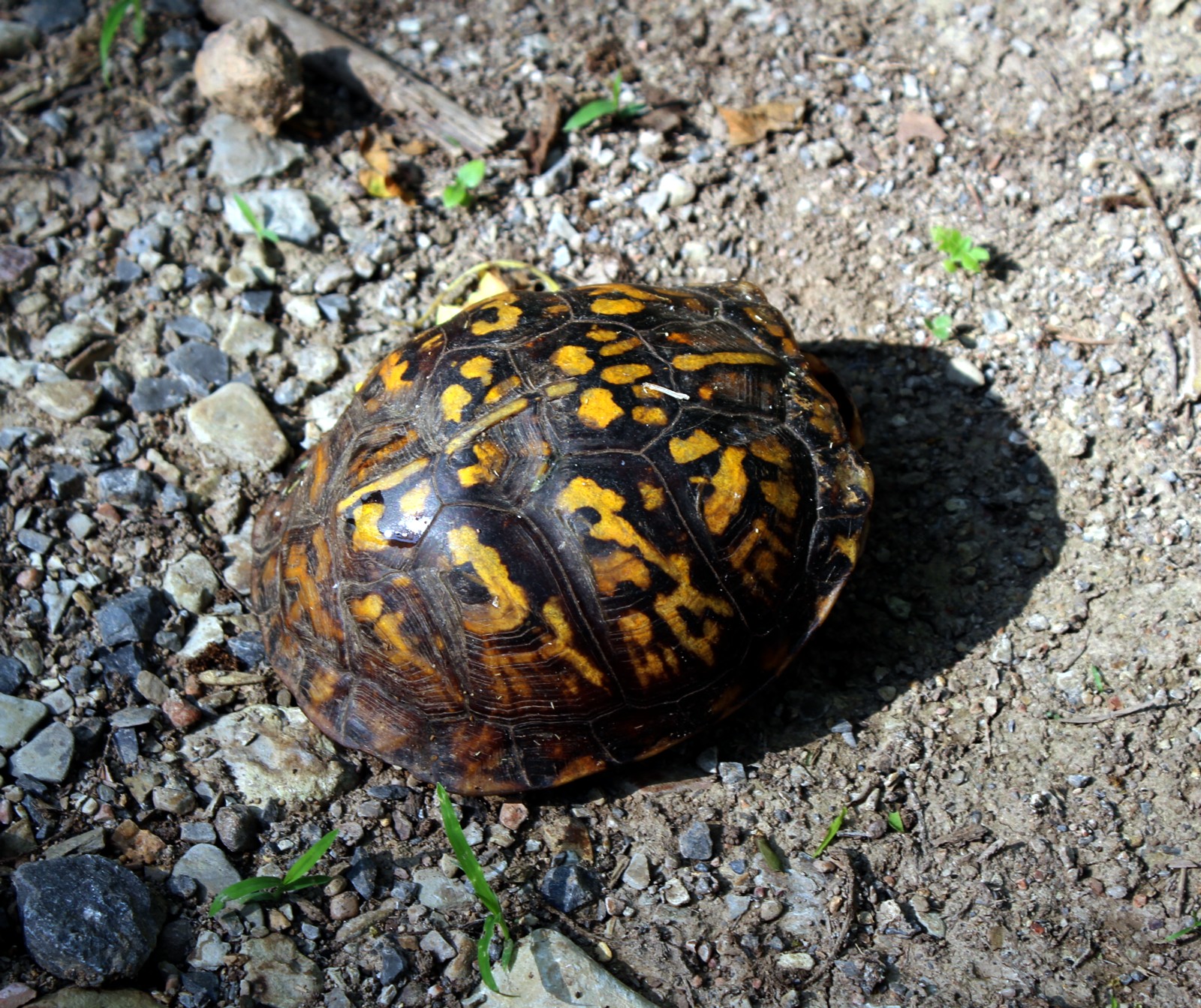
Students were excited to see two Eastern Box Turtles on the trail.  This one immediately went into its shell when confronted with that many seventh graders.  We learned a little about how the turtle's population has dropped mainly due to habitat loss.

 We also spotted a deer and waited for him to cross the road. 

 At the top, we posed for a group photo.


 Students spotted rainbow and brook trout in the reservoir.

We did not spot any turtles or deer on the afternoon hike.  Instead, we saw more butterflies (Eastern Tiger Swallotail, Red-Spotted Purples, White Cabbage) including this Eastern Comma Polygonia comma butterfly.  The spiders had spun webs and that seemed to attract a lot off attention too.


 I was first to spot this face!

 Again, we posed for a photo.

On both hikes, Ralph, local Mill Creek enthusiast and caretaker, talked about the history of the dam. 

 
The lower two rows of stone were chiseled and laid without cement in 1776-1780.  The upper concrete row was added in 1895 to make the reservoir larger. The reservoir formerly was the source of Narrows' water supply. 

Ralph also helped with explaining all the trees on the hike.  These were:

Butternut (White Walnut) Juglans cinerea
American Basswood (Linden, Linn, Beetree)  Tilia americana
Sweet Birch (Black Birch, Cherry Birch)  Betula lenta
Yellow Buckeye (Sweet Buckeye) Aesculus flava 

Besides these trees, we saw sugar and red maples, red and white oaks including chestnut oaks, ash, and other trees.   Students learned that because we are located in the middle section of the Appalachians, we get both southern and northern species, resulting in great diversity.


I have lived in Giles County for 31 years and had never hiked on this nice trail in the western part of the county.  No more--I plan to hike to the first big waterfall, one of many waterfalls, about a mile further up on this trail.  

Here is a link to a page containing the map of the trail:
http://www.townofnarrows.org/home/information/maps/

This link has directions to the Mill Creek Nature Park in Narrows, Virginia:
http://www.townofnarrows.org/departments/parks-recreation/mill-creek-nature-park-bike-rides/

Friday, February 13, 2009

Sugar Maple and Sapsucker: Be My Valentine!

This post really does have something to do with Valentine's Day--just keep reading.

Tuesday was a warm day, in the 60s, and sunny--perfect for working in the yard. My dog, Kookie, was busy chasing after chipmunks who were out that day. She chases them into their hole and then digs them out (why don't they just go up a tree?). Anyway, I just couldn't stand listening to her barking and digging, knowing that some poor little chipmunk was scared to death so I went after her.

Kookie was down in a hollow. I eased down the steep bank, using the trunk of a Sugar Maple to brace myself. That's when I realized it was completely wet. Examining the trunk, I found several holes, freshly drilled no doubt by the Yellow-Bellied Sapsucker. I tasted the water and it was faintly sweet--sap!

Later that afternoon, I went back to photograph the tree trunk but it was mostly dry. Before I approached the tree, I saw the sapsucker on a nearby hickory tree, drilling holes and somewhat annoyed at my presence.


This photo shows one hole on the sugar maple tree, about 1/4" in diameter with some sap still there. The hole is no deeper than about 1/2."


The crease on the right side of the trunk was caused by a series of holes done by the sapsucker in previous years. Most of the hickory trees (except shagbark) have these creases on them.

In the past, I wondered why the trunk of the Sugar Maple tree was black. Had it burned once? That's unlikely since the other trees were not black but most of the sugar maples were. I was thinking how the whole trunk was wet from the holes so this moisture probably fosters the growth of black mildew, something like you get in a shower.

The last two photos were taken this morning and the trunk was dry again. Was it because it was a little cooler (50s) and the sap wasn't running? Or, does the sapsucker have to drill new holes to get sap every time? I bet Nina can tell me since she taps sugar maples every year.

When I got back to the house, I made a Valentine wreath for the birds (similar to my holiday wreath--the post has the recipe for the suet cake). I hung the wreath on a small oak tree. By the time I got back inside, a downy woodpecker had already started eating.


Here is the wreath just a few minutes later with a Yellow-Bellied Sapsucker on it. He's been there for most of the afternoon, feasting on the peanut butter suet cake in the heart shaped cookie cutters and the little mesh bags full of peanut butter suet.


This White-Breasted Nuthatch has been sharing the wreath with the sapsucker.

Happy Valentine's Day everyone and please don't forget the birds.